 Title: The Worshipful Society of Type Founders and Alchemists
That’s a mouthful, but I had limited choices. I’d been doing research for several days on the naming of secret societies—a critical element in the novel I was working on. They all started out Worshipful, Sacred, Noble, Royal, Honorable. Then there was a type of organization: Society, Order, Guild, Association, Brotherhood. And then the subject. In my instance would it be Printers, Typesetters, Copyists, Typecasters… or Type Founders. I settled on the last because the one thing that made this ancient guild described in The Gutenberg Rubric unique was the fact that it was not centered on typesetting or printing, but on the casting of metal into type. I had it: The Worshipful Society of Type Founders… and Alchemists.
Where did that last term come in?
There is a good reason for including alchemy in the arts practiced by Gutenberg’s secret society in my new thriller. Alchemy was a proto-science (precursor to chemistry) focused on the transmutation of base substances into noble. We commonly think of it in terms of turning lead into gold, but the alchemist also strove to turn the corrupt body into an everlasting body. (See Harry Potter and the Philosopher’s Stone.)
We do know that Gutenberg was, by trade, a goldsmith. Yet, for some reason, he was running experiments with lead, tin, antimony, nickel, and copper. That was my first clue that Gutenberg may have been dabbling in alchemy—trying to come up with that perfect combination of elements that would, under the right conditions, turn into gold.
Beyond what is obvious in our 20th century enlightened minds, there was a problem with the process. Equal volumes of gold and lead do not weigh the same.
Back in the third century BC, the brilliant mathematician Archimedes was called upon by King Hiero II to determine whether all the gold that the king had given an artist had been used to make the crown he had commissioned. The crown weighed the right amount, but the king wanted to be sure that it was solid gold. Archimedes puzzled over the problem, but one day as he settled into the bath he observed how the water was displaced by his body. He realized that the same principle could be applied to his problem. The amount of water that was displaced when the crown was submerged should be the exact same as the amount displaced by pure gold of equal measure. Archimedes was so taken by this that he jumped out of the bath and ran down the street naked yelling “Eureka” or “I’ve found it!”
At the time of Gutenberg there were only 18 elements in the periodic table and the heaviest of them all was gold. Lead in an equal volume would weigh less. And that was the problem of the alchemists. They could combine metals to get something near the right hardness, but it was not as dense. The answer, of course, is to put the metal under pressure so that it will be compacted into a smaller volume. That theory seems valid, but it just doesn’t quite work. So, now we have the alchemist’s favorite elements and the need for a press that can exert many pounds of pressure. What failed to turn into gold, Gutenberg ultimately turned into lead type and a printing press.
Prior to Gutenberg, there had been many experiments in making movable type. In Europe, the most common was wood type. In Korea, clay type was in use, and in China, it was made of porcelain. Not strong enough, not even enough, too brittle. Early experiments with metal type failed because as the metal cooled from liquid to solid, it shrank. Larger letters shrank more than smaller ones, so an uneven print would be made with some characters hardly touching the paper at all.
But antimony is one of those rare (and toxic) elements that has the property of expanding when it cools, not unlike water turning to ice. The genius of Gutenberg’s invention was to make a metal alloy that was perfectly dimensionally stable, the expansion of the antimony exactly counteracting the contraction of the lead and tin.
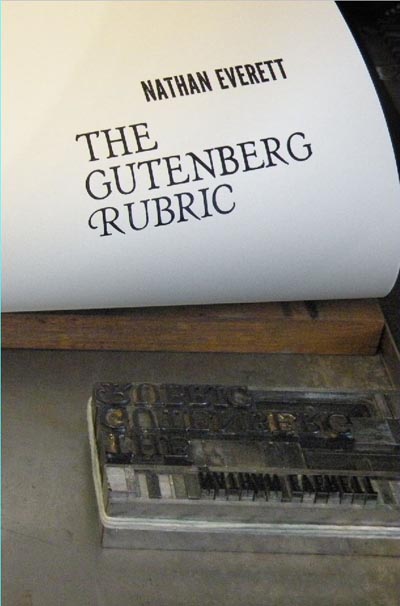 Just months before the Gutenberg Bible was finished in 1455, Gutenberg was sued by his financial partner Johan Fust. It seems that Gutenberg was siphoning off funds that Fust invested in order to pay for a secret project that he was working on outside the Bible-printing workshop. Gutenberg was ordered by the court to share the secret project with his financial partner. When Gutenberg refused, the court awarded the entire Bible-printing venture to Fust and Gutenberg was left with no profit from his invention but the secret project—a secret that was remains hidden to this day.
Was Gutenberg still working on an alchemical formula to turn lead into gold? We may never know, but I’ve taken that little mystery and woven an entire novel around it as two contemporary librarians attempt to discover the secret of The Gutenberg Rubric.
Links:
The Gutenberg Rubric: http://www.gutenbergrubric.com
The Rubricant Blog: http://www.gutenbergrubric.com/blog
Author Central: http://www.amazon.com/-/e/B004QVVE1S
Author Info:
Nathan Everett
nathan@nwesignatures.com











 Books: The Cheapest Vacation You Can Buy