Books: The Cheapest Vacation You Can Buy


{January 30, 2011}   The Red Pyramid, by Rick Riordan

Currently, I’m going through my bookshelves reading any books I haven’t yet read.  I buy up books by the dozen, and then put them on my shelves, where they patiently wait for me to pick them up and read them.  However, since I buy books quicker than I can read (alas), I tend to forget about the ones I previously bought.  As a new stack of books comes in, the previous stack gets pushed to the side.  To combat this, I’m working in a top to bottom, left to right format that forces me to read everything I already own.  It will also save me a little money seeing as I have over 60 books in my Barnes and Nobel “wish list,” nearly all of which are hardcover, since most of them are still “new.”  I’m hoping that when I finish off my bookshelves my “wish list” books will then be in paperback format (much cheaper).  However, this also means that most of the books I’ll be reading for the time being are older.  As much as I’d love to be reviewing novels “just off the press,” I really think I ought to finish what I already have.  It is only fair. 

Hence, I just read The Red Pyramid by Rick Riordan.  I’ve wanted to read this book for a while, but it’s HUGE!  Over 500 pages, hardcover… and other books came in before I got to it, so it’s been sitting on my shelf for a long, long time; I actually bought it when it first came out because I had just then finished Riordan’s Percy Jackson series (last May).  If you haven’t read those, then I highly suggest you do—they are much shorter than The Red Pyramid and are a wonderful read.  I learned so much about Greek mythology and the stories were fantastic, even if they are meant for young teens.  My students love them (though the movie stank to high heaven).  But anyway, this isn’t a review of the Percy Jackson books, so back to The Red Pyramid…
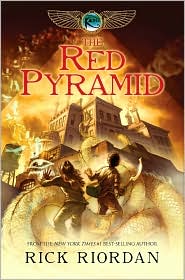
Without further ado, I’ll give you the synopsis from the dust jacket: “Since his mother’s death six years ago, Carter Kane has been living out of a suitcase, traveling the globe with his father, the brilliant Egyptologist Dr. Julius Kane. But while Carter’s been homeschooled, his younger sister, Sadie, has been living with their grandparents in London. Sadie has just what Carter wants—school friends and a chance at a “normal” life. But Carter has just what Sadie longs for—time with their father. After six years of living apart, the siblings have almost nothing in common. Until now.  On Christmas Eve, Sadie and Carter are reunited when their father brings them to the British Museum, with a promise that he’s going to “make things right.” But all does not go according to plan: Carter and Sadie watch as Julius summons a mysterious figure, who quickly banishes their father and causes a fiery explosion. Soon Carter and Sadie discover that the gods of Ancient Egypt are waking, and the worst of them—Set—has a frightening scheme. To save their father, they must embark on a dangerous journey—a quest that brings them ever closer to the truth about their family and its links to the House of Life, a secret order that has existed since the time of the pharaohs.”

__________________________

I loved this book!  I give it four stars right off the bat (fives are rare gems indeed).  Even though it is written for “tweens” and very young adults, and not in a mentally engaging way for an older crowd (cough, cough—me), I still really liked it.  Riordan has a way with words.  While some of the storyline of The Red Pyramid seemed “juvenile” to me, it didn’t override the story, and I just had to keep reading.  Riordan is capable of entrancing adult readers too, and that’s what I love about him—that’s why I’m able to keep on reading his books.   Sometimes I pick up young adult books to peruse and end up putting them right back down… I feel like they are trying too hard to reach “kids” through the lingo used, etc.  Thankfully I’ve never had this problem with Riordan.

The Red Pyramid is written much differently from the Percy Jackson series in that the reader actually becomes a part of the story through the use of second person narration.  You, the reader, are actually “reading” a transcript of voice-recorded tapes that the two protagonists left behind.  You are, therefore, invited right into the story, as your quest becomes finding “the locker” and using the combination that the protagonists give you—but in order to do that, you must “hear” their tale, because you, too, could be like them.  I am highly interested to see how Riordan is going to continue this usage of second person narration in the upcoming sequel, The Throne of Fire, releasing this May—just a few months away.  The end of The Red Pyramid makes it sound like you (the reader) have to find the locker and meet the protagonists in Brooklyn in order for the story to go on, so this narration style could get quite interesting.

I also just want to point out that in this book it is vital that you read everything.  For instance, there is a “Warning” listed on the page between the table of contents and the first chapter, and an “Author’s Note” after the completion of the novel.  Both of these aspects are actually a part of the novel themselves, though traditionally an author’s note deals with “thanks” and the research component of the novel.  However, times are changing, and I’ve noticed in newer books that the author usually has some type of introduction to the story prior to the first chapter (a must read, but usually glanced over by accident).  Likewise, on occasion the author will also have something after the conclusion of the novel, so it’s good practice to read everything just in case!  Happy reading!

Four stars for this novel!  


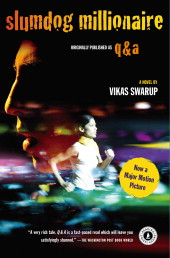
From the dust jacket: “Ram Mohammad Thomas has been arrested.  Because how can a poor orphan, who has never read a newspaper or gone to school, correctly answer all twelve questions on the television game show Who Will Win a Billion?—unless he has cheated?  As the story unfolds, Ram explains to his lawyer how he knew the answer to each question by telling a chapter of his amazing life—from the day he was salvaged from a dustbin to his meeting with a security-crazed Australian army colonel while performing as an overly creative tour guide at the Taj Mahal.  Stunning a television audience of millions, Ram draws on a store of street wisdom and accidental encounters that provides him with the essential keys not only to the quiz show but also to life itself.”

__________________________

You know those people who continually tell you that the book is SO much better than the movie, and that you just have to read the book because the movie left so much out?  Well, they’re right!  I always read the book first, before seeing the movie, but in this case, I did it backwards because… I didn’t know there was a book!  Forgive my ignorance… I’m going to blame it on the fact that the novel used to have a different name, Q and A, prior to the movie rendition coming out… sad to say the editors were right; Swarup will sell more books under the new title, but they got the title WRONG!!!  More on that later.

So, Slumdog Millionaire the book, versus Slumdog Millionaire the movie… no contest!  The book wins!  THEY AREN’T EVEN THE SAME STORY!  Yep, imagine my surprise!  I actually put off reading this book because the movie was really depressing for me, and I didn’t want to read about a girl forced into sexual servitude, or brothers feuding to the point of death… that stuff is too morbid for me.  But, I should have known!  I’ve seen enough books-turned-movies to know that Hollywood changes things all the time; it’s their artistic license, something my 9th graders are learning in our film studies unit right now. 

The only aspect of the book that was the same as the movie was the idea that an eighteen-year-old Indian orphan was arrested for winning the grand prize on the game show.  Okay, so a few of the stories, perhaps two, make it into the movie, but that’s the end of the similarities.  The names are different, the grand prize amount is different, the love story is different, the trials and tribulations of the main character are different… it’s just a completely different story, and I must say, I PREFER THE BOOK.  It’s much happier, for one thing.  While life as an orphan on the street is a terrible thing, Swarup focuses on the good things in the main character’s life (Ram), while the movie focuses on the morbid… and the REAL reason Ram went on the game show will blow you away.  When I got to the final question in the book, it ALL made sense.  It’s been a long time since I’ve read a novel that is successfully able to move backwards and forwards throughout a story AND tie it all together in the end.  Swarup did a phenomenal job with this book, and I agree with him that the name of his book should have remained  Q and A, but once again, producers and editors “change” things through artistic license, and now Swarup’s book is only known through the movie title.  Of course it will sell more with the same name as the movie, but the title DOESN’T do it justice… hello, Ram won a BILLION! 

Five stars for the novel!  

Two stars for the movie:


{January 28, 2011}   The Big Blogoversary Celebration

Make sure you check out http://www.sithereandread.com/ and http://narrativelyspeaking.blogspot.com/ for awesome giveaways!


{January 28, 2011}   Flood, by Stephen Baxter

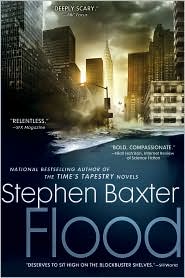
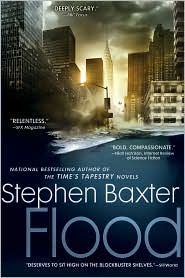
From the inside of the dust jacket:  “Four hostages are rescued from a group of religious extremists in Barcelona.  After five years of being held captive together, they make a vow to always watch out for one another.  But they never expected this…  The world they have returned to has been transformed—by water.  And the water is rising.  As climate predictions are tossed aside and the earth’s major cities are threatened, the former captives find themselves fighting this new threat on all fronts.  In his element, NASA scientist Gary Boyle throws himself into researching the extreme weather.  The storms can’t stop Helen Gray from searching for the baby she had in captivity.  With London drowning, British military officer Piers Michaelmas is at the forefront of his government’s response.  And the former USAF captain Lily Brooke finds herself in the employ  of a financial mogul—a man whose resources and ego outmatch any government’s in reshaping the future.  But water continues to flow from the earth’s mantle.  Entire countries disappear.  High ground becomes a precious commodity.  And finally, the dreadful truth is known:  Before fifty years have passed, there will be nowhere left to run.” 

________________________

I really don’t know how many stars to give Flood.  I’m on the fence.  It took me ten days to read, and usually I read a book a day.  Now, I know this is a long novel, but had it been riveting, I would have finished it in two days.  The first segment (2016) was very interesting to me.  It was about 110 pages long, and I was really into it, but then the book just lost its intensity.  The second segment (2017-2020) seemed very scientific, and while I guess that information needs to be there in order to authenticate the story, I was bored out of my mind.  I kept putting the book down.  Everything seemed to develop so slowly, and the fast paced flooding of the world was now inching along.  Honestly, I lost interest, and when I realized that this novel actually takes place over 30 years, and is written in chucked sections, skipping up to five years at a time, I was really put off. 

But, I always finish a book.  So I read on, in spurts.  The character development, I feel, was non-existent.  On one occasion I wrote a friend about the novel and stated that, “At this point, I hope all the characters drown—the character development is non-existent anyway, and I wouldn’t care if they all died… but they won’t because I read the last page (bad habit). Ugh.”  I always find it sad when I’m reading a novel and the characters don’t “speak” to me.  I feel like that is happening more and more often, and I don’t know if it’s the books I choose, or just me. 

However, Flood wasn’t all bad.  Like I said, the first segment was riveting.  The middle was… bland.  But it picked up again.  Somewhere in the middle of section three (2020-2035) it started to get interesting again, and once section four came about (2035-2041), it really picked up.  The ending, section five (2041-2052), which was gratefully the shortest section, yet spanned nine years, was satisfying in its own right, though there really isn’t any closure.  It’s very ominous and left open for the readers interpretation.  I hate when books do that, but it fit this novel very well. 

All in all, I think this book would have been phenomenal had it been pared down to about 200 pages, and not 500 (my copy is 500 pages, but it is my understanding that there are longer copies out there… bigger print?).  The story itself was a great idea, and it was scary, though not is a horror show kind of way.  It really makes you think about the stability of the earth, and what is to come in the future. 

I do wish there was a better way to go about tracking the story over the 30+ years the novel covers, but perhaps there is no better way than to jump around.  I understand that it would be inconceivable to have the earth flood any quicker—you’ll have to read it to see why—but still, all the minute details, and the long stretches in between the story (jumping from 2020-2025) just wasn’t my style.  Perhaps you’ll find it more satisfactory. 

And so, we’re back to my beginning statement: I really don’t know how many stars to give Flood.  I’m on the fence.  I’m in between “it was okay,” and “I liked it.”  I mean, in retrospect, it was just okay; I’m never going to re-read it, but I liked parts of it, and in the end, it really made me think, and I actually couldn’t sleep!  So… I’m somewhere in-between.  Let’s go with two and a half stars. 


This is my new theme song!!  

Thanks to www.juliansmith.tv (for making this) and http://www.alicemarvels.com/ (for sending me an email with the video).  This is just too good, and so are BOTH of those sites!  Check them out!


et cetera