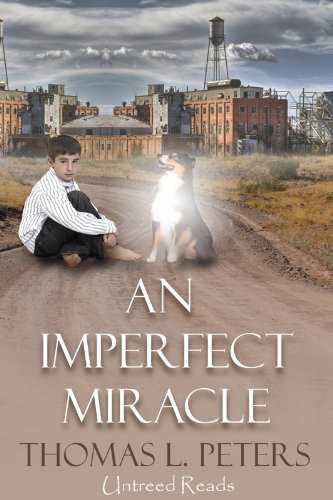
 From Goodreads: Nathan Gray has trouble making friends, his alcoholic father ran out on him, his mother is preoccupied with work and finding a new husband and his dog Chewy has just died. So perhaps it’s not surprising that Nate comes to believe that his beloved Chewy has returned from the dead to once again be his best friend. His mother is alarmed, but the therapist predicts that Nate will grow out of his habit of “seeing things” once he comes to grips with his emotional traumas.
But then, on his way to school, Nate stumbles upon what he can only describe as a miracle – a man seemingly healed of a fatal head wound by a smudge on an old, dingy concrete wall. Nate might be on to something that can’t be attributed to his imagination, as many in his small industrial Pennsylvania town, quickly ascribe spiritual significance to the smudge, and healing powers too.
Some of the town’s leading citizens decide to capitalize on the sudden influx of tourists by turning the smudge into a shrine and charging admission. Not everybody is on board with the notion that the miraculous has somehow intruded into their mundane routine, and Nathan soon finds himself at the center of a raging controversy. AN IMPERFECT MIRACLE is a moving piece of literary fiction dealing with love, loss and one boy’s attempts to find substance and clarity in a chaotic world.
_________________________________
This is an extremely interesting story about a spiritual icon that shows up in a rundown area of a sleepy little town. I’ve never read anything remotely like it, and I really enjoyed how Peters created mystery throughout the story based on Nathan’s character. Nathan, having an invisible dog, Chewy, becomes a suspect characters from the very beginning. As the story is told from the first person point of view, the reader must note that all the information received is coming through Nathan himself—and the fact that he can see his deceased dog ultimately forces the reader to question everything Nathan says—including what he sees in terms of Mary’s spiritual icon and her healing properties. I thought this was an ingenious way to tell the story, especially as it doesn’t force the reader to take a side with either the Catholic or Protestant religion. In fact, the story itself isn’t really about religious sects at all, but rather Nathan’s perception of events surrounding him.
Peters kept me on edge throughout the entire novel, especially as I attempted to analyze Nathan and all that he presents to the reader. I was surprised by the ending and found myself reanalyzing Nathan, especially as information concerning the icon became available, forcing me to change my opinions of him once again. This is a truly interesting look at the inner workings of human beings and I highly recommend it to all! Four stars!

I received a copy of this novel from the publisher in exchange for an honest review.










 Books: The Cheapest Vacation You Can Buy