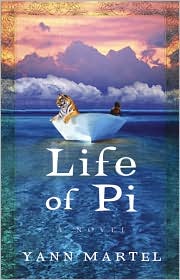
 Usually I’d write the synopsis here, but there doesn’t seem to be one. All the back of the book states is that it’s about “a boy of many faiths. A 450-pound Bengal Tiger. A shipwreck. A lifeboat. The Pacific Ocean.” Interested?
________________________________
I don’t know where to start… if you really liked the movie Cast Away, you might like this novel. I decided to read Life of Pi because it has been a recommendation on tons of book lists, and the idea of a boy and a tiger stranded at sea together is very intriguing, but, I HATED Cast Away, and I really disliked this book. In fact, I wouldn’t have even finished it if I hadn’t read the last chapter halfway through the novel. It’s a bad habit of mine, I know, but in this case, it actually lead to me finishing the entire novel, instead of chucking it across the room and obtaining something better from the bookshelf. Wow. Seriously, the entire first section of the novel should go right in the trash. I couldn’t care less about how Pi got his name from a swimming pool, or how his father ran a zoo, or how Pi couldn’t decide on one religion so he chose three… I just don’t care. It also isn’t pertinent to the storyline. All Part 1 does—all 117 pages of it—is give background information of the main character, and once the real story begins, the story about the shipwreck and the tiger, all of part one becomes obsolete. Just cut part one right out of the book and you’ll be good to go.
Part two is much better, but there is an overkill of description because there are no characters for Pi to talk to, so he describes everything. I guess I never really knew that I loved dialogue so much, until it was completely taken away from me in this book. Halfway through part two I became restless and I read the end, and there is such a huge twist at the end of the novel that it redeemed the book, a tiny bit. But… this book is so dry that you might not even make it to the ending. My suggestion: Read the last chapter first. Then you can decide if reading the entire novel is worth your time. It wasn’t worth mine, but at least the twist at the end moved the book up one star, in my opinion, and one star is all it’s going to get.











 Books: The Cheapest Vacation You Can Buy
It is not so much that The Life of Pi, is particularly moving (although it is). It isn’t even so much that it is written with language that is both delicate and sturdy all at once (which it is, as well). And it’s certainly not that Yann Martel’s vision filled passages are so precise that you begin to feel the salt water on your skin (even though they are). It is that, like Bohjalian and Byatt and all of the great Houdini’s of the literary world, in the last few moments of your journey – after you’ve felt the emotions, endured the moments of heartache, yearned for the resolution of the characters’ struggle – that you realize the book is not what you thought it was. The story transforms, instantly, and forever.
And in those last few chapters, you suddenly realize that the moral has changed as well.
You feel Martel’s words lingering, suggesting, and you find yourself wondering whether you are his atheist who takes the deathbed leap of faith – hoping for white light and love? Or the agnostic who , in trying to stay true to his reasonable self, explains the mysteries of life and death in only scientific terms, lacking imagination to the end, and, essentially, missing the better story?
There is no use in trying to provide a brief synopsis for this ravishing tale of a young boy from India left adrift in the Pacific in a lifeboat with a tiger who used to reside in his father’s zoo in Pondicherry. There is no use because once you finish the book you might decide that this was not, indeed, what the book was about at all. There is no use because, depending on your philosophical bent, the book will mean something very different to your best friend than it will to you. There is no use because it is nearly impossible to describe what makes this book so grand.
Read this book. Not because it is an exceptional piece of literary talent. It is, of course. But there are many good authors and many good books. While uncommon, they are not endangered. Read this book because in recent memory – aside from Jose Saramago’s arresting Blindness – there have been no stories which make such grand statements with such few elements. As Pi says in his story “Life on a lifeboat isn’t much of a life. It is like an end game in chess, a game with few pieces. The elements couldn’t be more simple, nor the stakes higher.” It is the same with Martel’s undulating fable of a book about a boy in a boat with a tiger. A simple story with potentially life altering consequences for it’s readers.
As Martel writes, “The world isn’t just the way it is. It is how we understand it, no? And in understanding something, we bring something to it, no?” Like Schroedinger’s cat in the box, the way this book is understood, the way it is perceived affects what it is. There has been some talk that this book will make it’s readers believe in god. I think it’s a question of perspective. To behold this gem of a novel as an adventure of man against the elements (the “dry, yeastless factuality” of what actually happened) is certainly one way to go about it. But to understand this piece to be something indescribable, something godlike, is by far the greater leap of faith.