Currently, I’m going through my bookshelves reading any books I haven’t yet read. I buy up books by the dozen, and then put them on my shelves, where they patiently wait for me to pick them up and read them. However, since I buy books quicker than I can read (alas), I tend to forget about the ones I previously bought. As a new stack of books comes in, the previous stack gets pushed to the side. To combat this, I’m working in a top to bottom, left to right format that forces me to read everything I already own. It will also save me a little money seeing as I have over 60 books in my Barnes and Nobel “wish list,” nearly all of which are hardcover, since most of them are still “new.” I’m hoping that when I finish off my bookshelves my “wish list” books will then be in paperback format (much cheaper). However, this also means that most of the books I’ll be reading for the time being are older. As much as I’d love to be reviewing novels “just off the press,” I really think I ought to finish what I already have. It is only fair.
Hence, I just read The Red Pyramid by Rick Riordan. I’ve wanted to read this book for a while, but it’s HUGE! Over 500 pages, hardcover… and other books came in before I got to it, so it’s been sitting on my shelf for a long, long time; I actually bought it when it first came out because I had just then finished Riordan’s Percy Jackson series (last May). If you haven’t read those, then I highly suggest you do—they are much shorter than The Red Pyramid and are a wonderful read. I learned so much about Greek mythology and the stories were fantastic, even if they are meant for young teens. My students love them (though the movie stank to high heaven). But anyway, this isn’t a review of the Percy Jackson books, so back to The Red Pyramid…
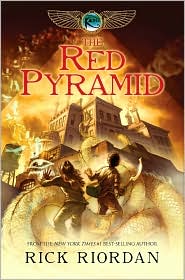 Without further ado, I’ll give you the synopsis from the dust jacket: “Since his mother’s death six years ago, Carter Kane has been living out of a suitcase, traveling the globe with his father, the brilliant Egyptologist Dr. Julius Kane. But while Carter’s been homeschooled, his younger sister, Sadie, has been living with their grandparents in London. Sadie has just what Carter wants—school friends and a chance at a “normal” life. But Carter has just what Sadie longs for—time with their father. After six years of living apart, the siblings have almost nothing in common. Until now. On Christmas Eve, Sadie and Carter are reunited when their father brings them to the British Museum, with a promise that he’s going to “make things right.” But all does not go according to plan: Carter and Sadie watch as Julius summons a mysterious figure, who quickly banishes their father and causes a fiery explosion. Soon Carter and Sadie discover that the gods of Ancient Egypt are waking, and the worst of them—Set—has a frightening scheme. To save their father, they must embark on a dangerous journey—a quest that brings them ever closer to the truth about their family and its links to the House of Life, a secret order that has existed since the time of the pharaohs.”
__________________________
I loved this book! I give it four stars right off the bat (fives are rare gems indeed). Even though it is written for “tweens” and very young adults, and not in a mentally engaging way for an older crowd (cough, cough—me), I still really liked it. Riordan has a way with words. While some of the storyline of The Red Pyramid seemed “juvenile” to me, it didn’t override the story, and I just had to keep reading. Riordan is capable of entrancing adult readers too, and that’s what I love about him—that’s why I’m able to keep on reading his books. Sometimes I pick up young adult books to peruse and end up putting them right back down… I feel like they are trying too hard to reach “kids” through the lingo used, etc. Thankfully I’ve never had this problem with Riordan.
The Red Pyramid is written much differently from the Percy Jackson series in that the reader actually becomes a part of the story through the use of second person narration. You, the reader, are actually “reading” a transcript of voice-recorded tapes that the two protagonists left behind. You are, therefore, invited right into the story, as your quest becomes finding “the locker” and using the combination that the protagonists give you—but in order to do that, you must “hear” their tale, because you, too, could be like them. I am highly interested to see how Riordan is going to continue this usage of second person narration in the upcoming sequel, The Throne of Fire, releasing this May—just a few months away. The end of The Red Pyramid makes it sound like you (the reader) have to find the locker and meet the protagonists in Brooklyn in order for the story to go on, so this narration style could get quite interesting.
I also just want to point out that in this book it is vital that you read everything. For instance, there is a “Warning” listed on the page between the table of contents and the first chapter, and an “Author’s Note” after the completion of the novel. Both of these aspects are actually a part of the novel themselves, though traditionally an author’s note deals with “thanks” and the research component of the novel. However, times are changing, and I’ve noticed in newer books that the author usually has some type of introduction to the story prior to the first chapter (a must read, but usually glanced over by accident). Likewise, on occasion the author will also have something after the conclusion of the novel, so it’s good practice to read everything just in case! Happy reading!
Four stars for this novel! 











 Books: The Cheapest Vacation You Can Buy
I can’t wait to have time to read this!
I think you’ll enjoy it! I can’t decide if I like Egyptian mythology more or less than I like Greek mythology! I will say that I learned a lot about both through reading Riordan’s books. :)